Why It Is Necessary to Thoroughly Evaluate Coworking Management Software - en
May 28, 2026
Mục lục
- Why is it necessary to thoroughly evaluate coworking management software?
- 10 Most Important Criteria for Evaluating Coworking Management Software
- 1. Suitability with the actual operation model of coworking
- 2. Intuitive, easy-to-use interface (UX/UI)
- 3. "All-in-one" management on one platform
- 4. Meets the core functions of the coworking model
- 5. Intuitive Reporting & Dashboard System
- 6. Customization and Scalability
- 7. Ability to Assign Roles and Control Data
- 8. Absolute Data Security
- 9. Reasonable Cost Compared to Received Value
- 10. Support and Implementation Team Always Accompany
- 3-Step Process for Choosing Effective Software
- FAQ - Frequently Asked Questions When Choosing Coworking Management Software
- How long does it take to implement coworking management software?
- Can data be transferred from Excel to coworking management software?
- Can coworking management software integrate with other tools?
- Should we prioritize software with the most features?
- After implementation, does the business need to retrain the team?
In the context of the booming coworking space model (coworking space), systematic operation is no longer a "nice-to-have" option but has become a vital condition for growth. As the scale of tenants expands, operations from booking, contracts to invoices continuously arise, making management with Excel overloaded and prone to errors.
That is why businesses need professional coworking management software. However, choosing the wrong tool can lead to "money lost and trouble gained".
So what are the core criteria to evaluate a solution before investing? Let's explore more with Smartos in this article!
Why is it necessary to thoroughly evaluate coworking management software?
Managing a coworking space is not simply a matter of booking. It is a combination of:
- Infrastructure management (seats, meeting rooms, private offices).
- Financial management (contracts, debts, invoices).
- Experience management (amenities, customer care).
If the system lacks integration, your team will have to work on many disparate tools, leading to fragmented data.
Thorough evaluation helps you choose a "digital assistant" flexible enough to accompany you from the startup phase to later expansion.

10 Most Important Criteria for Evaluating Coworking Management Software
Understanding the importance of applying technology to space operations, but to find management software that meets your needs well and optimizes operations, you can evaluate based on the following criteria:
1. Suitability with the actual operation model of coworking
The first criterion when choosing coworking management software is the level of suitability with the actual business model.
Each space has its own characteristics: some are strong in hourly seating (Hot desk), others specialize in renting completely separate, enclosed workspaces (Private Office) for the long term. The ideal software must support a variety of booking types (flexible/fixed) and additional services (pantry, events, parking) on a single interface.
2. Intuitive, easy-to-use interface (UX/UI)
Good software not only needs to be strong in functionality but also easy to operate. In reality, system users are not always tech-savvy. The team can include receptionists, sales, admin, accountants, operations managers, or business owners. If the interface is too complex, training time will be extended, staff may easily make mistakes, and ultimately revert to Excel or work outside the system.
Conversely, a simple, clear, and friendly interface will help the team get acquainted faster, use the system more consistently, and significantly reduce errors during operation.
3. "All-in-one" management on one platform
Prioritize solutions that allow seamless connection from: Booking -> Contract creation -> Service recording -> Invoice issuance -> Debt tracking.
Having all data in one place allows you to reconcile instantly without manual compilation.
When all data is on the same platform, businesses will save a lot of time and reduce the risk of information loss.
4. Meets the core functions of the coworking model
Many businesses tend to look at the number of features to evaluate software. But in reality, the important thing is not how many features the software has, but whether it has the right features needed for coworking.
Suitable software should well support core functions such as:
- Real-time management of meeting room/seat status.
- Storage of individual & business customer records.
- Automated payment reminders and contract renewals.
- Incident management and support request system (Ticketing).
These are also functional groups very close to the actual operational needs of the coworking and rental office model.
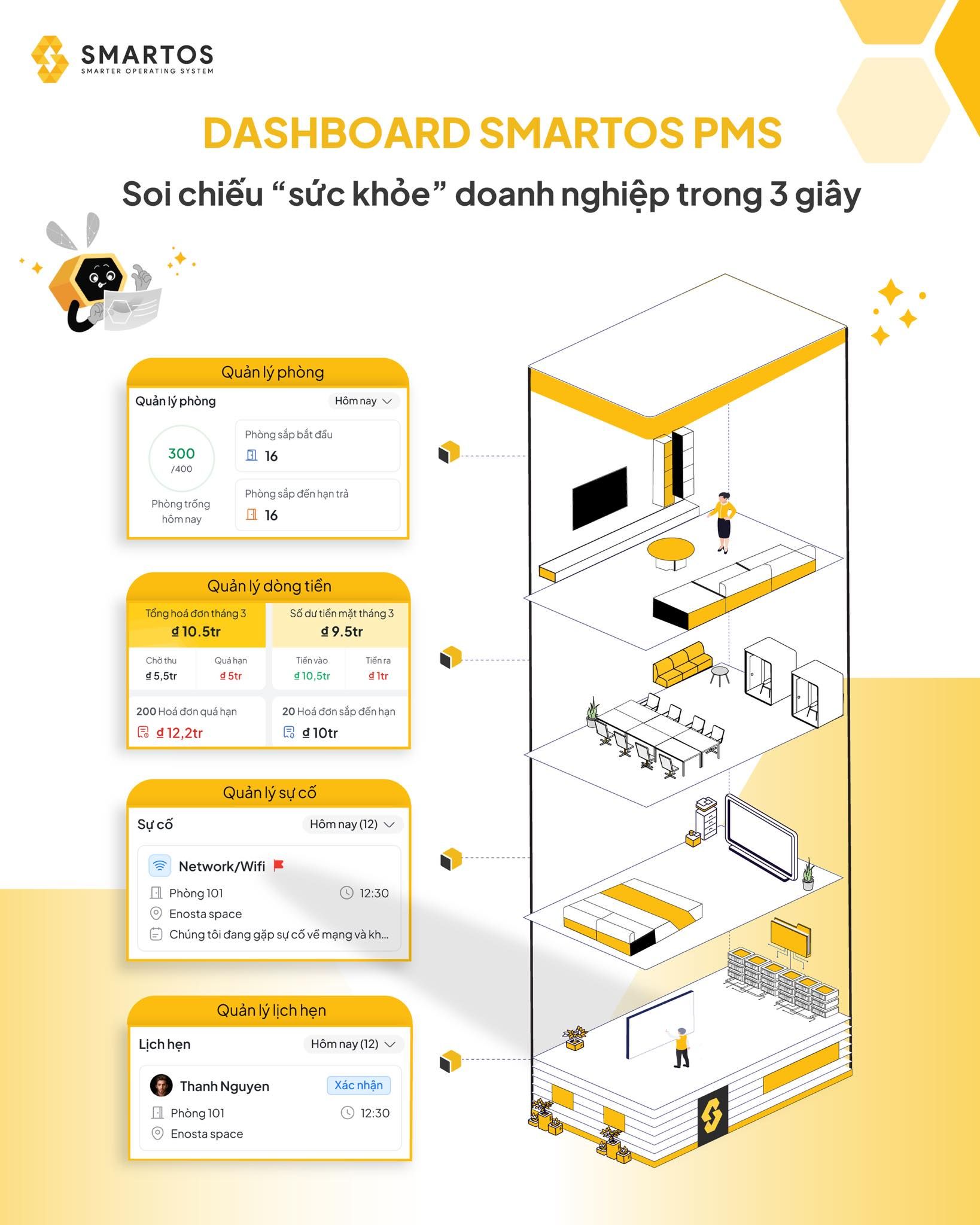
5. Intuitive Reporting & Dashboard System
The software must act as a "brain" supporting decision-making. Managers need to see immediately: occupancy rates, revenue by branch, customer growth charts… instead of waiting for accountants to export Excel files or just acting as a data entry point.
6. Customization and Scalability
If in the future you open 5-10 more branches, can the current software handle the load?
Choose a solution that supports multi-location management to avoid having to change systems when the business grows.
7. Ability to Assign Roles and Control Data
For coworking and rental office models, the need to monitor at multiple user levels is very clear.
For example: receptionists focus on booking and check-in, accountants track invoices and debts, the operations department handles incidents, while the CEO or business owner views the overall report.
Clear role assignment not only smooths the process but also increases security and reduces errors during work.
8. Absolute Data Security
The software is where almost all important business data is stored: customer information, contracts, invoices, payment history, operational data, and financial reports. Therefore, security is an indispensable criterion when choosing coworking management software.
Ask the provider to commit to: regular backup policies, cloud security, and the reputation of the development team.
9. Reasonable Cost Compared to Received Value
Cost is always a factor that businesses consider first, but it should not be the only factor.
Currently, there are many software solutions on the market with very different prices. Some solutions have low initial costs but lack core features or are difficult to implement in practice. There are also high-priced solutions that are not really suitable for operational needs in Vietnam.
Therefore, instead of just asking "how much does it cost", businesses should ask "what do I get for that price". When viewed from the perspective of usage efficiency, the cost equation will be much more realistic.
10. Support and Implementation Team Always Accompany
Good software but difficult to implement can still become a burden.
Many businesses do not encounter problems with the product but face difficulties during data conversion, usage guidance, team training, and handling issues arising in the early stages. Therefore, when evaluating software, you should also evaluate the provider's ability to accompany you.
The Onboarding phase (getting familiar with the system) is always the most difficult. A provider that understands the Vietnamese market, has a 24/7 support team, and is willing to customize features on demand will be a big plus.
3-Step Process for Choosing Effective Software
Step 1: Clearly Identify the Problem to Solve
Don't start with the question "which software is the best", but start with the question "where am I most stuck".
Some businesses struggle with fragmented booking. Some have issues with contracts, invoices, and debts. Others lack reports or find it difficult to control when opening multiple locations. Identifying the right problem will help you evaluate the software more realistically.
Step 2: Request a Realistic Demo According to the Operational Process
When viewing a demo, ask the provider to simulate your business journey: from customer interest, booking, contract signing, service recording, invoice issuance, payment to operational reporting.
Doing so, you will clearly see whether the software is truly suitable or just "seems comprehensive".
Step 3: Evaluate Both the Product and the Ability to Accompany
Besides features, see if the provider understands the coworking model, provides advice closely aligned with actual operational problems, and has sufficient capacity to support during the implementation phase.

FAQ - Frequently Asked Questions When Choosing Coworking Management Software
How long does it take to implement coworking management software?
The implementation time depends on the scale of operations, the amount of data to be converted, and the complexity of the current process. For small models, the time can be quite fast if the data has been standardized. For models with many locations, various rental types, and multiple departments involved, the implementation time will be longer due to the need for configuration, role assignment, and thorough training.
Can data be transferred from Excel to coworking management software?
Yes. This is a very common need for many businesses when starting to digitize operations. However, the speed of conversion will depend on whether the old data is stored clearly and consistently. Therefore, when evaluating software, businesses should ask the provider about the data import process, supported file templates, and the level of support during the conversion phase.
Can coworking management software integrate with other tools?
Many businesses do not only use a single system but also use additional tools like email, Zalo, CRM, accounting software, or timekeeping and payment tools. Therefore, integration capability is a criterion worth considering. Software with flexible connectivity will help businesses reduce manual operations, better synchronize data, and limit duplicate data entry.
Should we prioritize software with the most features?
Not necessarily. More features are not always better if the software is difficult to use or has many functions that do not fit your model. The important thing is that the software must meet the core operations that the business needs, be easy to implement, easy to use, and support future expansion.
After implementation, does the business need to retrain the team?
Yes, but the extent will depend on the software's user-friendliness and the provider's support capability. A good system still requires initial guidance so departments understand their roles, operational processes, and how to coordinate on the platform. Training from the start will help businesses utilize the software more effectively and reduce the staff's reluctance to change.
Choosing through coworking management software evaluation criteria should not stop at comparing costs or looking at a few standout features. More importantly, is the software truly suitable for your operational model, easy for the team to use, supports centralized management, is secure enough, can expand with business scale, and helps managers make better decisions?
For businesses operating coworking or rental offices, the need to manage bookings, contracts, invoices, reports, customers, and multi-department operations is increasingly clear. Smartos is built from the real difficulties of managing coworking spaces and is developed with a focus on centralized management, process optimization, and enhancing customer experience. Additionally, the system also focuses on functional groups such as booking, contracts, invoices, services, operational reporting, and multi-branch management.
Are you ready to digitally transform your coworking space? Contact Smartos to receive a free trial and schedule a direct consultation today!
Share: